

1
/
of
6
Gatekeepers LA
The Wedding at Cana
The Wedding at Cana
Regular price
$67.00 USD
Regular price
Sale price
$67.00 USD
Unit price
/
per
Shipping calculated at checkout.
Couldn't load pickup availability
- The Wedding at Cana — Paolo Veronese, 1562–1563
Few paintings in the history of Western art were conceived with the sheer ambition of Paolo Veronese’s The Wedding at Cana. Measuring nearly **10 meters wide—more than 32 feet across—**the monumental canvas transforms a biblical miracle into one of the most extravagant spectacles of the Venetian Renaissance.
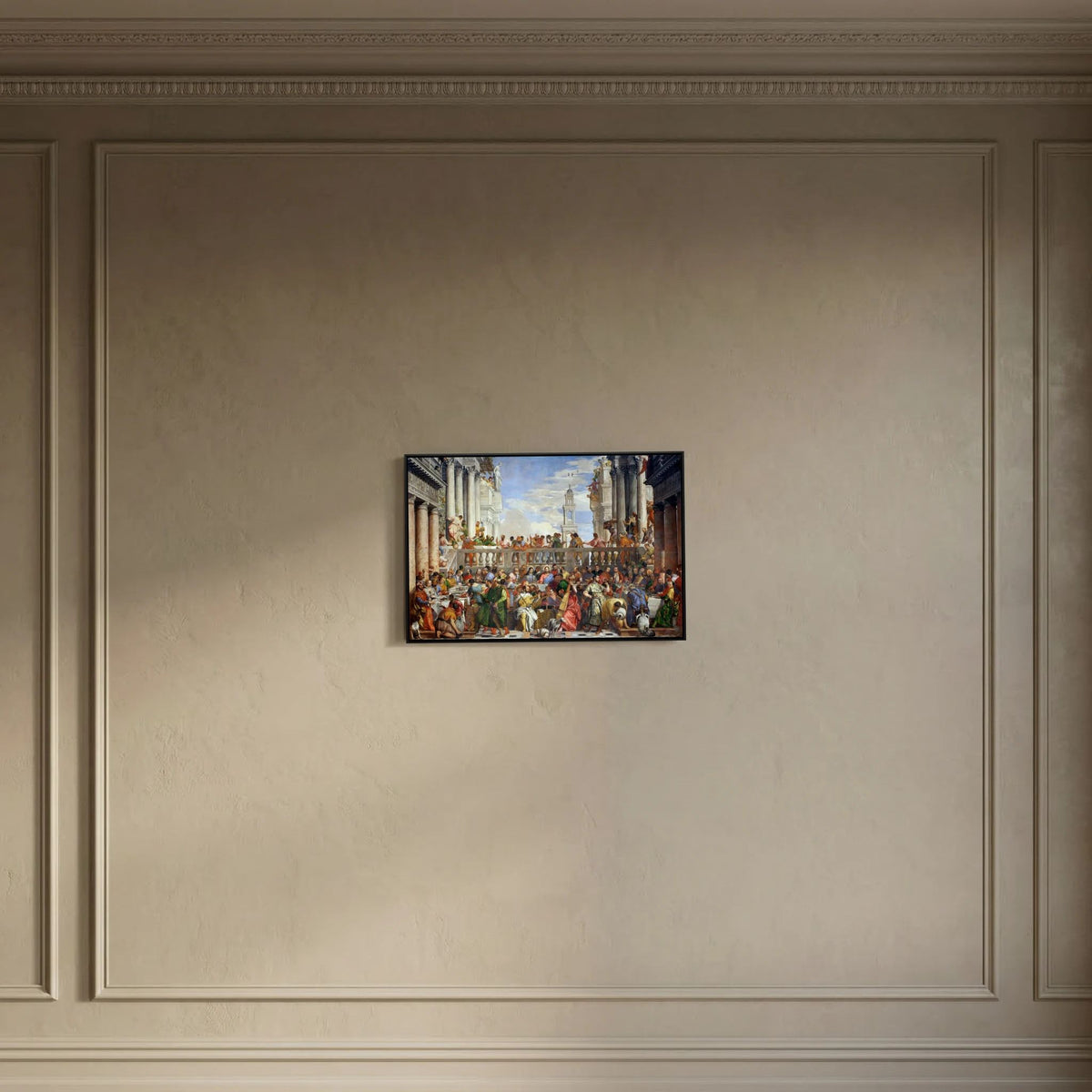
Commissioned in 1562 for the Benedictine monastery of San Giorgio Maggiore in Venice, Veronese was asked to create a work worthy of the vast refectory designed by Andrea Palladio. Rather than depicting the Wedding at Cana as an intimate religious scene, he imagined it as an enormous Venetian banquet: marble architecture rises toward an open blue sky, musicians perform at the center of the festivities, servants move through the crowd, and more than a hundred richly dressed figures fill the composition.
At the exact center sits Jesus Christ, remarkably still amid the surrounding abundance. Beside him is the Virgin Mary. Around them unfolds the moment described in the Gospel of John, when Christ performs his first public miracle—transforming water into wine after the wedding feast has exhausted its supply.
Yet Veronese makes the sacred event almost deliberately difficult to find. The viewer is first overwhelmed by color, architecture, silk, food, music, animals and human activity. Only gradually does the eye return to the quiet figure of Christ. That contrast between earthly spectacle and spiritual stillness gives the painting much of its extraordinary power.
The feast also became a portrait of Renaissance imagination itself. Figures within the enormous gathering have traditionally been associated with rulers, intellectuals and artists of Veronese’s world, while the musicians occupying the foreground have famously been interpreted as portraits of great Venetian painters—including Veronese himself, Titian, Tintoretto and Jacopo Bassano. Whether every identification is literal or legendary, their presence reinforces the painting's remarkable merging of biblical antiquity with sixteenth-century Venice.
The scale of the original is difficult to comprehend through reproduction alone: approximately 22 feet high and 32½ feet wide. Veronese completed this immense canvas in roughly fifteen months, creating not simply an illustration of scripture but an entire world—a theatrical celebration of architecture, fashion, music, wealth, faith and human life.
Today, The Wedding at Cana hangs in the Louvre Museum in Paris, directly across from Leonardo da Vinci’s Mona Lisa. While crowds gather around Leonardo's comparatively tiny portrait, Veronese's colossal masterpiece occupies virtually an entire wall—a striking reminder of how some of history's greatest works can remain overlooked even while standing in plain sight.
This museum-quality digital canvas print brings the extraordinary color, architectural grandeur and intricate storytelling of Veronese's masterpiece into a contemporary setting. Particularly commanding at large scale, it becomes more than wall decoration: it creates a focal point capable of defining an entire room, equally suited to expansive residences, dining spaces, libraries, offices, hotels and richly considered interiors.
Gatekeepers exists for works exactly like this. Masterpieces of extraordinary scale, history and beauty can sit beyond the gates of museums and collections, known by millions yet truly examined by relatively few. Our purpose is to reopen those gates—allowing remarkable works from our shared artistic inheritance to be rediscovered, studied and lived with once again.
Commissioned in 1562 for the Benedictine monastery of San Giorgio Maggiore in Venice, Veronese was asked to create a work worthy of the vast refectory designed by Andrea Palladio. Rather than depicting the Wedding at Cana as an intimate religious scene, he imagined it as an enormous Venetian banquet: marble architecture rises toward an open blue sky, musicians perform at the center of the festivities, servants move through the crowd, and more than a hundred richly dressed figures fill the composition.
At the exact center sits Jesus Christ, remarkably still amid the surrounding abundance. Beside him is the Virgin Mary. Around them unfolds the moment described in the Gospel of John, when Christ performs his first public miracle—transforming water into wine after the wedding feast has exhausted its supply.
Yet Veronese makes the sacred event almost deliberately difficult to find. The viewer is first overwhelmed by color, architecture, silk, food, music, animals and human activity. Only gradually does the eye return to the quiet figure of Christ. That contrast between earthly spectacle and spiritual stillness gives the painting much of its extraordinary power.
The feast also became a portrait of Renaissance imagination itself. Figures within the enormous gathering have traditionally been associated with rulers, intellectuals and artists of Veronese’s world, while the musicians occupying the foreground have famously been interpreted as portraits of great Venetian painters—including Veronese himself, Titian, Tintoretto and Jacopo Bassano. Whether every identification is literal or legendary, their presence reinforces the painting's remarkable merging of biblical antiquity with sixteenth-century Venice.
The scale of the original is difficult to comprehend through reproduction alone: approximately 22 feet high and 32½ feet wide. Veronese completed this immense canvas in roughly fifteen months, creating not simply an illustration of scripture but an entire world—a theatrical celebration of architecture, fashion, music, wealth, faith and human life.
Today, The Wedding at Cana hangs in the Louvre Museum in Paris, directly across from Leonardo da Vinci’s Mona Lisa. While crowds gather around Leonardo's comparatively tiny portrait, Veronese's colossal masterpiece occupies virtually an entire wall—a striking reminder of how some of history's greatest works can remain overlooked even while standing in plain sight.
This museum-quality digital canvas print brings the extraordinary color, architectural grandeur and intricate storytelling of Veronese's masterpiece into a contemporary setting. Particularly commanding at large scale, it becomes more than wall decoration: it creates a focal point capable of defining an entire room, equally suited to expansive residences, dining spaces, libraries, offices, hotels and richly considered interiors.
Gatekeepers exists for works exactly like this. Masterpieces of extraordinary scale, history and beauty can sit beyond the gates of museums and collections, known by millions yet truly examined by relatively few. Our purpose is to reopen those gates—allowing remarkable works from our shared artistic inheritance to be rediscovered, studied and lived with once again.
Product safety information (GPSR)
Manufacturer: Varkey Titus, 7850 SW 13th St, 68523-9076 Lincoln, United States
Safety information: Decorative wall art. Not a toy. Keep mounting hardware and small parts away from children. Mount securely to a suitable wall.
Share